Most wholesale buying guides stop at 'compare several suppliers and check quality'. That is not a framework — it is a wish. This article walks through the three numbers that actually decide whether a pet product line makes money: the true landed cost, the MOQ cash commitment, and the maximum purchase price your retail margin can tolerate. Everything here uses figures you can verify with any serious supplier in a first email.
1. A factory quote is never one number
When a supplier quotes USD 11.80 for an elevated pet cot, that price is only meaningful once you know which trade term sits behind it — freight, duty and clearance can swing the same quote by several dollars per unit. The three terms this site works with form a ladder: under FOB the factory clears export and delivers the goods on board at the loading port; CNF adds the ocean freight; CIF adds insurance on top of that. None of the three includes duty, destination charges or the inland move — those are always yours.
A practical rule, argued in full in our landed cost guide: ask the same supplier to quote two trade terms side by side — the gap shows their export handling cost and makes cross-supplier quotes comparable. Our own quote sheet lists MOQ, lead time and trade terms per model and size — the wholesale elevated bed range shows how this looks in practice.
2. MOQ math: what your first order actually costs
MOQ is not a barrier — it is a cash planning input. Why 300 pieces per size is the realistic factory-floor baseline, and how customization (a new Pantone color, a woven label, retail-ready packaging) moves the number, is broken down in our wholesale buyer's guide; what matters here is what that number does to your first-order cash.
Work the first order backwards from cash, not forwards from ambition. Say your target retail price is USD 39.90 and a supplier quotes USD 11.80 FOB at 300 pieces. Your first-order commitment is roughly:
- Goods: 300 × 11.80 = USD 3,540
- Freight for roughly 6-8 cbm of folded cots (they pack flat): USD 700-1,100 depending on lane and term
- Samples and courier: expect a sample fee plus a sample courier fee — budget USD 150-300 total
- Total cash to first sellable inventory: about USD 4,400-4,900, excluding duty
That is the real entry ticket for one SKU. Multiply by five SKUs and you understand why experienced buyers launch with one or two hero products instead of a full range. If you want packed dimensions for a specific model to compute cbm before you commit, request a quote — we reply with carton size and gross weight per model.
3. Reverse-calculate your maximum purchase price
Instead of asking 'is this price good?', ask 'what price can I afford?' The formula most retail buyers use:
Max purchase price = Target retail × (1 - marketplace fees - target margin) - freight per unit - duty per unit
Example: USD 39.90 retail on a marketplace taking 15 percent, target margin 40 percent, freight and duty together USD 2.10 per unit. Max purchase price = 39.90 × 0.45 − 2.10 = USD 15.86. Any FOB quote under that number is workable; anything above it needs either a better-packed design (lower shipping volume), a simpler material spec, or a higher retail plan. This single calculation kills more bad product ideas before they cost money than any other test.
4. Dimension and weight decide profit more than unit price
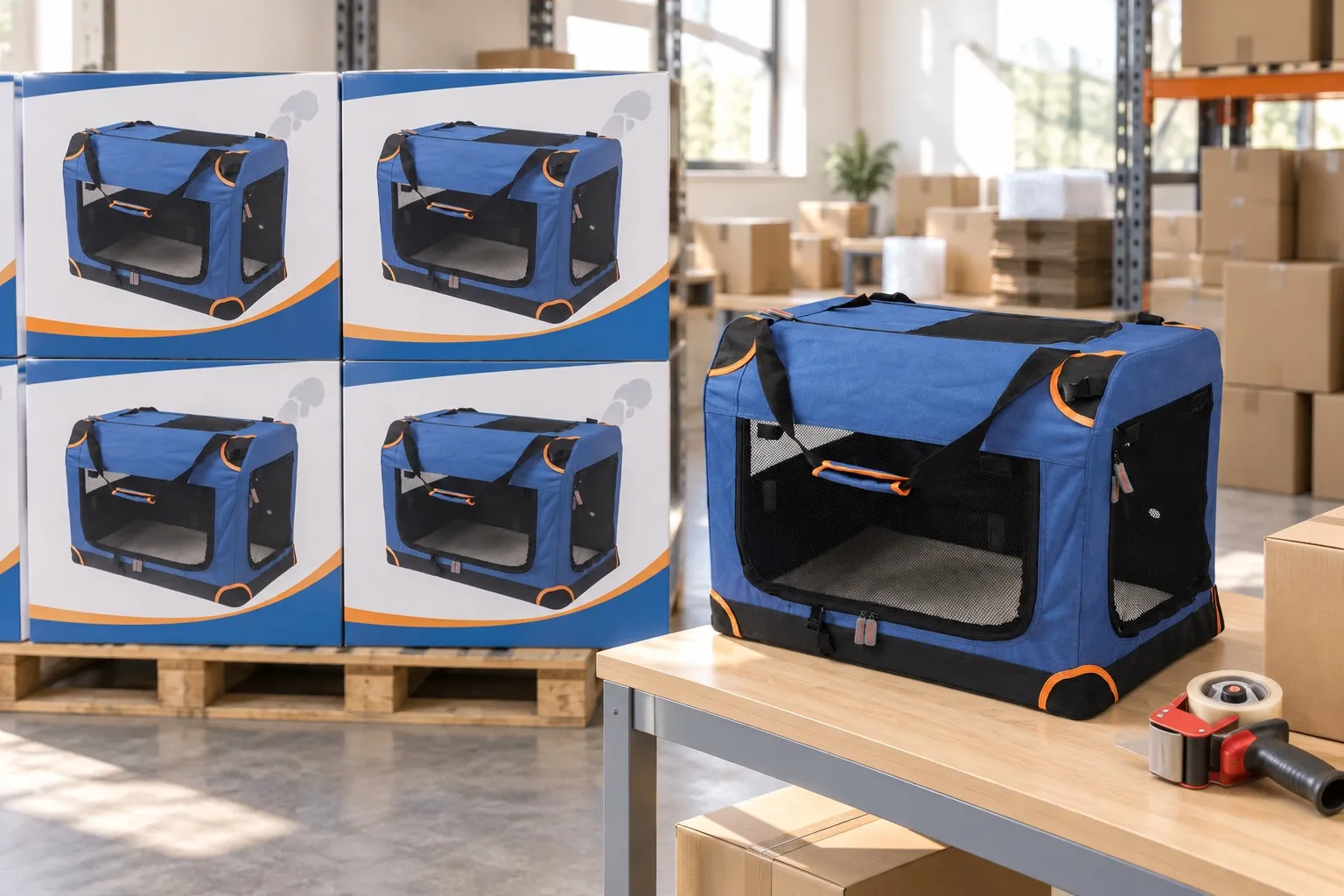
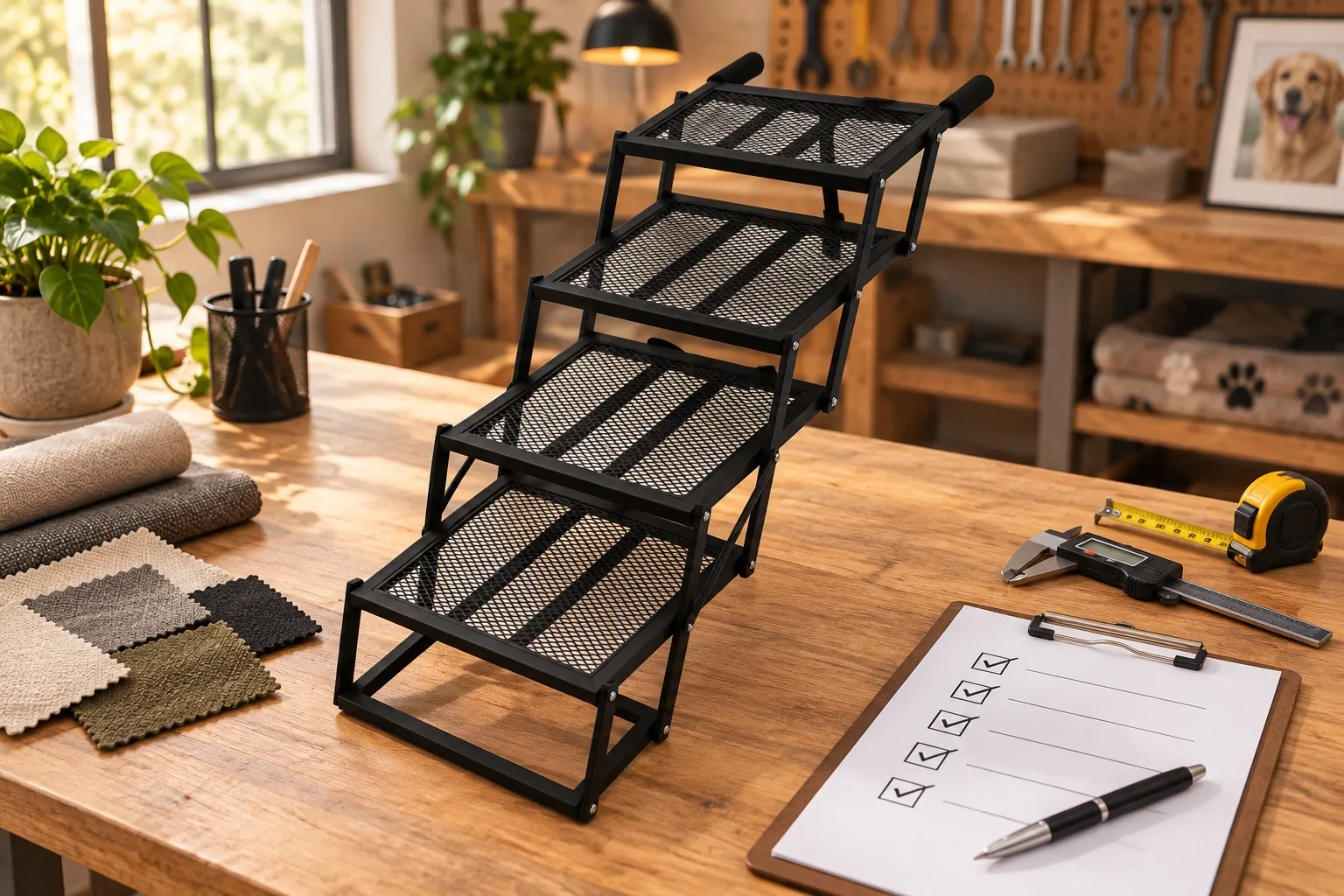
Pet products are bulky relative to their value, so freight often moves 15-30 percent of your landed cost. Two beds with the same USD 12 factory price are not equal if one packs at 43×30×9.5 cm and the other at 77×60×20 cm — the second consumes four times the container space. This is why flat-folding designs dominate the category: foldable ramps, foldable crates and elevated cots with detachable legs exist precisely because packed volume is money.
When comparing suppliers, normalize every quote to landed cost per unit including freight, then compare again. The supplier with the higher FOB price frequently wins once packed volume enters the math.
5. A sane first-order structure
- 1-2 hero SKUs at factory MOQ, standard colors, your logo on the label if the supplier allows it at low volume.
- One sample round before production — never skip it, and expect 7-10 days for samples to be ready.
- Written specification sheet signed before deposit: sizes, fabric weight, tube gauge, packaging, carton marks.
- Payment via T/T 30/70 with the balance tied to a pre-shipment inspection — the structure our payment terms guide argues in full; pause at any supplier demanding 100 percent upfront.
- Book inspection before paying the balance — even a simple photo checklist catches most packing errors.
If you are building a range rather than a single hero product, browse the category structure first — beds, ramps, crates and tents each carry different MOQ economics — then talk to suppliers who can grow across lines without you re-vetting factories every season.
The takeaway
Wholesale selection is arithmetic before it is taste. Fix your retail plan, reverse-calculate the affordable purchase price, force every quote into landed-cost terms, and let packed volume break ties. Suppliers who help you run this math quickly are the ones worth keeping; suppliers who resist it are telling you something.